Description
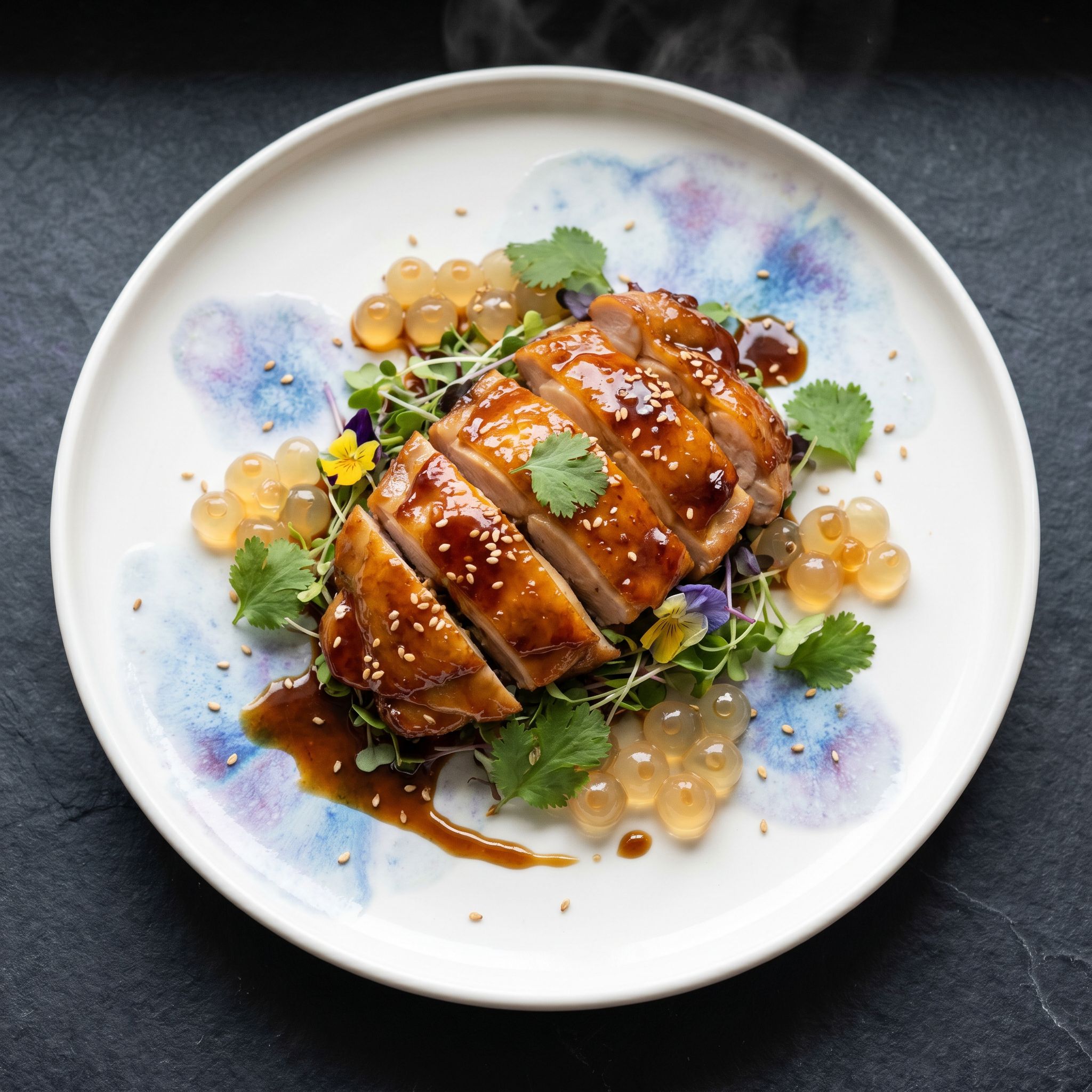
Tender sous-vide chicken thighs glazed in a sticky honey garlic reduction, paired with bursting soy-honey spheres that release sweet-savory liquid on the tongue. Key flavors combine caramelized garlic and floral honey with umami depth. The molecular spherification technique creates a futuristic pop while remaining simple with store-bought sodium alginate.
Cultural Background
Honey garlic chicken draws from Chinese-Canadian cuisine, where sweet-savory sauces blending honey, soy, and garlic became popular in the mid-20th century through immigrant adaptations of Cantonese flavors. Sous-vide cooking originates from French techniques developed in the 1970s for precise temperature control in professional kitchens. Molecular spherification was pioneered by Spanish chef Ferran Adrià at elBulli in the early 2000s, transforming everyday ingredients into innovative textures inspired by global modernist gastronomy.
Recipe Info
PREP TIME: 25 minutes
COOK TIME: 2 hours 10 minutes
TOTAL TIME: 2 hours 35 minutes
SERVINGS: 4
DIFFICULTY: Medium
Ingredients
- 8 boneless skinless chicken thighs (about 2 pounds total)
- 1 teaspoon kosher salt
- 1/2 teaspoon black pepper
- 2 tablespoons neutral oil for searing
- 1/2 cup honey
- 1/4 cup soy sauce
- 4 cloves garlic minced
- 2 tablespoons rice vinegar
- 1 teaspoon cornstarch mixed with 1 tablespoon water (optional for thickening)
- 200 ml soy sauce
- 100 ml honey
- 1.5 g sodium alginate (0.5% of total liquid volume)
- 5 g calcium chloride
- 1 liter distilled water for calcium bath
- Fresh cilantro leaves for garnish
- Sesame seeds for garnish
Instructions
- Preheat a sous-vide water bath to 165°F (74°C). Season the chicken thighs with salt and pepper, place in a vacuum-seal bag or zip-top bag using the water displacement method, and submerge in the bath for 2 hours until very tender and juicy.
- While the chicken cooks, prepare the soy-honey spherification liquid by whisking together 200 ml soy sauce and 100 ml honey until fully combined; the mixture should be smooth and slightly viscous.
- Weigh out 1.5 g sodium alginate and blend it into the soy-honey mixture using an immersion blender until completely dissolved with no lumps, about 2-3 minutes; let rest for 10 minutes to allow air bubbles to escape.
- Prepare the calcium bath by dissolving 5 g calcium chloride in 1 liter of distilled water in a shallow bowl; stir until fully dissolved.
- Using a squeeze bottle or dropper, carefully drip the alginate mixture into the calcium bath to form small spheres about 1 cm in diameter; allow them to set for 1-2 minutes, then gently remove with a slotted spoon and rinse in a bowl of clean water to stop the reaction.
- Remove the chicken from the sous-vide bath, pat dry thoroughly with paper towels, and sear in a hot skillet with 2 tablespoons neutral oil over high heat for 1-2 minutes per side until golden brown.
- In a small saucepan over medium heat, combine 1/2 cup honey, 1/4 cup soy sauce, 4 cloves minced garlic, and 2 tablespoons rice vinegar; bring to a simmer and cook for 3-5 minutes until thickened and glossy, stirring frequently; add cornstarch slurry if needed for extra stickiness and simmer 1 more minute.
- Glaze the seared chicken thighs with the honey garlic reduction, reserving some sauce for plating.
- To serve, slice the glazed chicken thighs and arrange on plates with 8-10 soy-honey spheres per serving scattered around; drizzle with remaining sauce and garnish with cilantro and sesame seeds.
Tips
- Ensure the sodium alginate fully dissolves and the mixture rests to avoid cloudy or broken spheres; test one sphere first before making the batch.
- Pat the chicken very dry before searing to achieve a proper crust without steaming.
- Substitute calcium lactate for calcium chloride in the bath if a less bitter taste is preferred, using the same 0.5% concentration.
Nutrition
Calories: 520
Protein: 38g
Carbs: 42g
Fat: 22g
Tags
Imagine a dish from the year 3000 that u