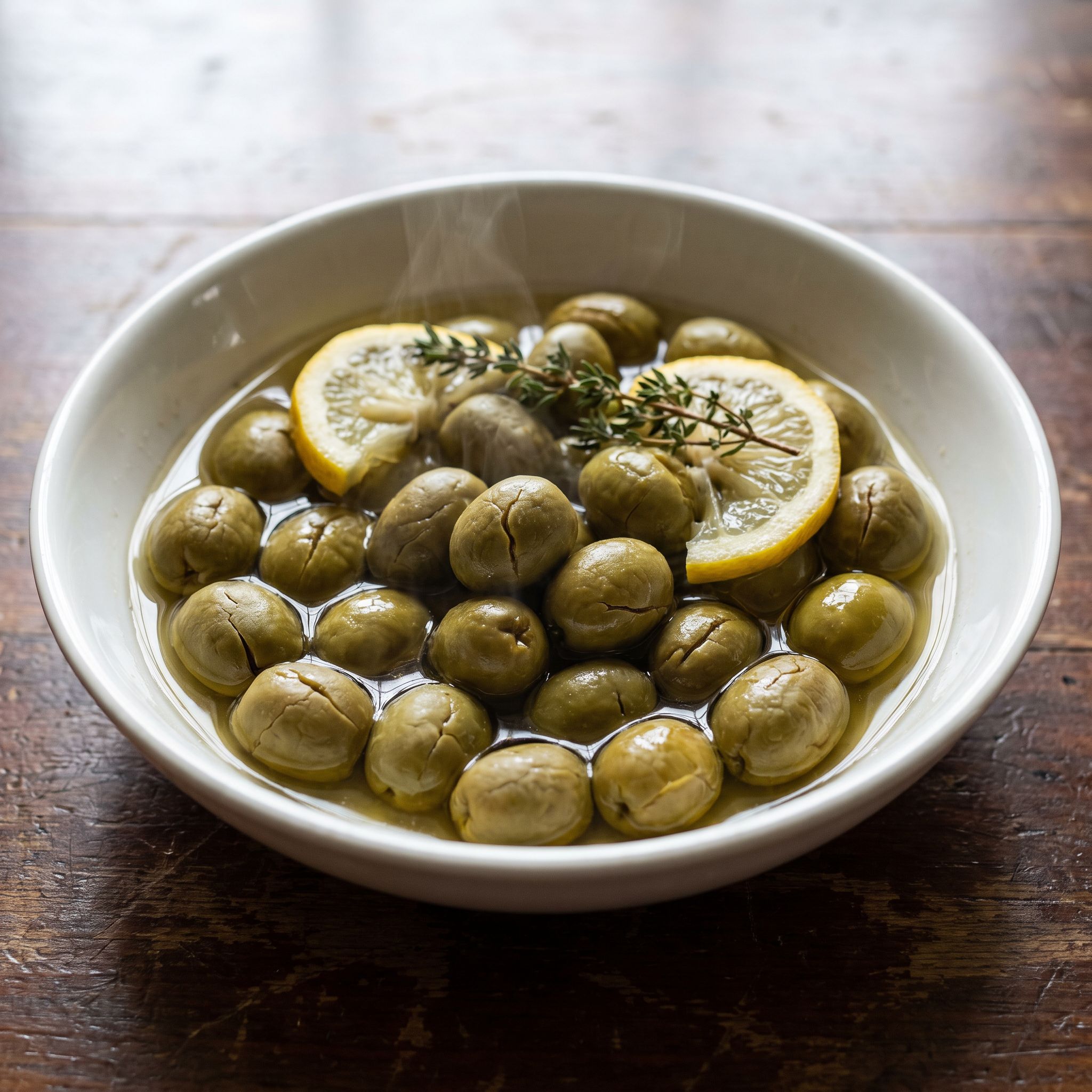
Description
Fresh olives hold a bitter compound called oleuropein inside their flesh. Daily changes of plain water pull that compound out by diffusion until the olives lose their harsh taste and can safely enter a salt brine.
Cultural Background
Olive trees were first cultivated in the eastern Mediterranean more than six thousand years ago. At a submerged site called Kfar Samir off the coast of modern Israel, archaeologists found the earliest known olive pickling setup from about 6500 years ago, with pits and structures used to process the fruit. The Minoans on Crete expanded large-scale olive growing during the Bronze Age around 2000 BCE, producing both oil and table olives for storage and trade across the Aegean. Ancient Greeks later refined dry-salt methods for ripe black olives, while Romans adopted lye treatments for faster results. Oleuropein is a phenolic molecule that binds to taste receptors and creates intense bitterness. In water curing, repeated soaking lets the water-soluble oleuropein molecules move out of the olive cells into the surrounding liquid through simple diffusion across concentration gradients. Salt in the final brine draws additional moisture from the olives by osmosis while creating an environment where lactic acid bacteria can slowly ferment remaining sugars. The key craft step is keeping every olive fully submerged at all times, because any exposure to air allows mold spores to grow on the surface and spoil the batch. Changing the water daily prevents the leached bitterness from reaching equilibrium and re-entering the fruit. A surprising true fact is that people produced olive oil centuries before they learned to eat the fruit itself.
Recipe Info
PREP TIME: 30 minutes
COOK TIME: 0 minutes
TOTAL TIME: 4 to 6 weeks
SERVINGS: 20
DIFFICULTY: Medium
Ingredients
- 1 kilogram fresh green or turning olives
- Water, enough to cover olives by 5 centimeters each day
- 100 grams coarse sea salt or pickling salt
- 1 liter filtered water for brine
Instructions
- Adult: Rinse the olives and use a mallet or the flat side of a knife to gently crack each one without splitting it open.
- Place the cracked olives in a large non-metal container and cover them completely with cool water.
- Change the water every day for 2 to 4 weeks, tasting one olive after the second week to check when bitterness has faded.
- Adult: Dissolve the salt in the liter of filtered water to make the brine.
- Drain the olives and cover them with the brine, keeping every olive submerged with a weight.
- Leave the olives in the brine in a cool dark place for at least 2 more weeks before tasting.
Tips
- The olives turn soft or slimy if water changes are missed or if they sit above the liquid.
- Use kosher salt if pickling salt is unavailable.
- Add a few garlic cloves or lemon slices to the final brine for extra flavor next time.
Nutrition
Calories: 40
Protein: 0.3 g
Carbs: 1 g
Fat: 4 g