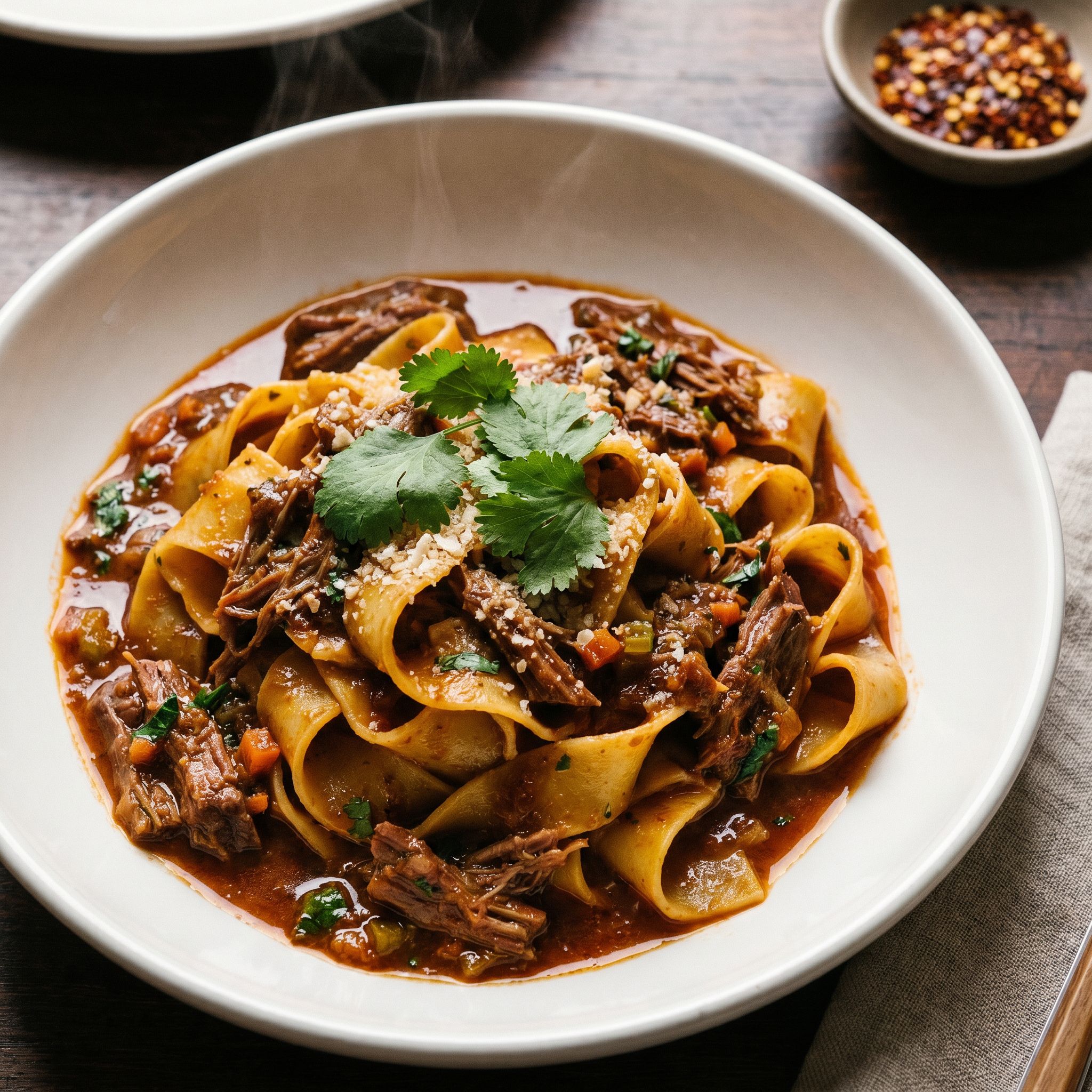
Description
Slow-braised beef brisket in a rich Malaysian rendang spice paste of coconut, chilies, and galangal, finished with Italian soffritto and served over pappardelle. Sicilian tomato depth meets Cantonese braising for a hearty, aromatic fusion pasta dish that simmers to tender perfection in roughly 3 hours. This cross-cultural creation blends the dry, caramelized intensity of rendang with the saucy comfort of ragu and the tender braising techniques of brisket traditions.
Cultural Background
Rendang originated in the Minangkabau region of Indonesia and became a staple in Malaysian and Singaporean cuisine as a ceremonial slow-cooked dish symbolizing patience and richness through coconut milk reduction. Cantonese Chinese braising methods for tough cuts like brisket emphasize aromatic spices and long simmering for tenderness, while Jewish Ashkenazi brisket traditions add layered onion and carrot depth in similar low-and-slow preparations. Italian and Sicilian ragu techniques contribute soffritto and tomato bases for umami, with broader Southeast Asian influences from Thai, Vietnamese, Thai, Filipino, and Indonesian elements like lemongrass and fish sauce enhancing the spice profile, alongside nods to Afghani, Lebanese, Turkish, Mexican, Tex-Mex, Israeli, French, and Mongolian flavor bridges through shared spices and braising.
Recipe Info
PREP TIME: 30 minutes
COOK TIME: 3 hours
TOTAL TIME: 3 hours 30 minutes
SERVINGS: 6
DIFFICULTY: Hard
Ingredients
- 1.5 kg beef brisket, cut into 4-5 large chunks
- 2 tbsp vegetable oil
- 1 large onion, finely diced
- 2 carrots, finely diced
- 2 celery stalks, finely diced
- 400 ml full-fat coconut milk
- 200 ml beef stock or water
- 400 g canned San Marzano tomatoes, crushed
- 1 tbsp fish sauce
- 1 tbsp soy sauce
- 2 tsp palm sugar or brown sugar
- 500 g dried pappardelle pasta
- Salt and black pepper to taste
- Fresh cilantro or Thai basil for garnish
- Grated Parmesan for serving
- Spice Paste:
- 12 dried red chilies, soaked in hot water and drained
- 6 shallots, roughly chopped
- 6 garlic cloves
- 3 stalks lemongrass, white part only, sliced
- 3 tbsp fresh galangal, chopped
- 2 tbsp fresh ginger, chopped
- 1 tsp ground turmeric
- 1 cinnamon stick
- 3 star anise
- 4 cloves
- 3 cardamom pods
- 2 makrut lime leaves
Instructions
- Prepare the spice paste by blending the soaked chilies, shallots, garlic, lemongrass, galangal, ginger, and turmeric in a food processor until smooth, adding a splash of water if needed to form a thick paste; set aside.
- Pat the brisket chunks dry and season generously with salt and pepper. Heat 2 tablespoons of oil in a large Dutch oven or heavy pot over medium-high heat until shimmering, then sear the brisket in batches for 4-5 minutes per side until deeply browned; remove and set aside.
- Reduce heat to medium and add the diced onion, carrots, and celery to the same pot; cook the soffritto for 8-10 minutes, stirring often, until softened and lightly caramelized with golden edges.
- Add the prepared spice paste to the soffritto and cook for 5-7 minutes, stirring frequently, until the paste darkens slightly and becomes fragrant, releasing its aromatic oils without burning.
- Return the seared brisket to the pot along with the coconut milk, beef stock, crushed tomatoes, fish sauce, soy sauce, palm sugar, cinnamon stick, star anise, cloves, cardamom, and lime leaves; bring to a gentle boil, then reduce to a low simmer, cover partially, and braise for 2.5 to 3 hours until the brisket is fork-tender and easily shreds, stirring occasionally and adding a splash of water if the sauce thickens too much.
- Remove the brisket pieces, shred or cut into bite-sized chunks, discard the whole spices, and return the meat to the pot; simmer uncovered for 15-20 minutes more to reduce the sauce to a thick, glossy ragu consistency that coats the back of a spoon.
- Meanwhile, cook the pappardelle in a large pot of salted boiling water according to package directions until al dente, about 8-10 minutes; drain, reserving 1 cup of pasta water.
- Toss the drained pappardelle directly into the rendang ragu sauce over low heat, adding a splash of reserved pasta water if needed to emulsify and coat evenly; cook together for 1-2 minutes until the pasta absorbs flavors.
- Divide among serving bowls, garnish with fresh cilantro or Thai basil and grated Parmesan, and serve immediately while hot.
Tips
- Toast the whole spices briefly in a dry pan before adding to the paste for enhanced aroma and depth without bitterness.
- Avoid rushing the reduction step at the end, as proper caramelization of the coconut milk is key to authentic rendang flavor and prevents a raw coconut taste.
- For a milder version, substitute half the dried chilies with fresh milder varieties or reduce quantity; beef chuck can substitute brisket if unavailable.
Nutrition
Calories: 920
Protein: 52 g
Carbs: 68 g
Fat: 48 g
Tags
Meat dish, Malaysian, Cantonese Chinese, Mongolian, Vietnamese, Singaporean, Thai, Filipino, Indonesian, Afghani, Italian, Sicilian Italian, French, Ashkenazi Jewish, Tex-Mex, Mexican, Israeli, Lebanese, Turkish