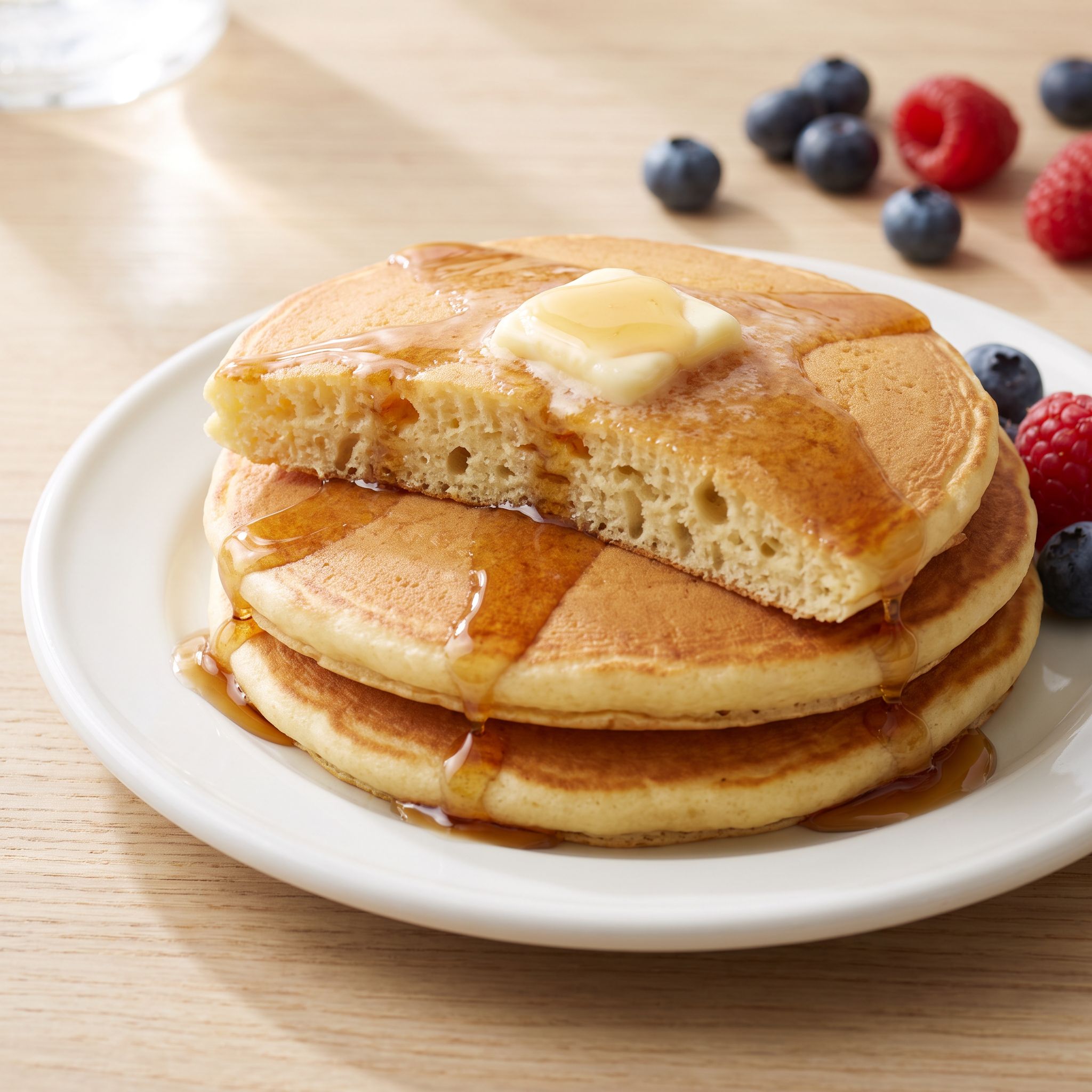
Description
Baking powder releases carbon dioxide gas into the wet batter, forming bubbles that expand with heat to lift the pancakes. Starch granules from the flour take up water and swell into a soft gel once the mixture reaches 60 to 75 degrees Celsius.
Cultural Background
Pancakes appear in Jewish cooking as early as the 12th century in Germany. Cheese versions called cassola reached Italy by the 14th century through Sicilian Jewish cooks who had been expelled from Spain. These pancakes honored the story of Judith, who fed cheese and wine to an enemy general in ancient times. The custom of eating dairy foods on Shavuot, the spring festival marking the giving of the Torah, reinforced the use of milk and butter in such dishes. In the 19th century potato latkes largely replaced the older cheese ones in Eastern Europe once potatoes became common. The key chemical change occurs when baking powder meets liquid and heat. Sodium bicarbonate and an acid inside the powder react to produce carbon dioxide gas. Those gas pockets expand and set the structure as the batter cooks. Starch granules packed inside the flour absorb water and lose their ordered crystal-like arrangement above 60 degrees Celsius. Gluten proteins in the flour form only weak links if mixing stays brief, keeping the texture tender rather than chewy. The surface reaches temperatures high enough for the Maillard reaction, where amino acids from proteins join with sugars to create browned, aromatic compounds. Adult supervision during cooking prevents the pan from overheating and ensures even browning. A surprising fact is that the earliest documented Hanukkah pancakes were made with cheese, not potato.
Recipe Info
PREP TIME: 10 minutes
COOK TIME: 15 minutes
TOTAL TIME: 25 minutes
SERVINGS: 4
DIFFICULTY: Easy
Ingredients
- 1 1/2 cups all-purpose flour
- 3 1/2 teaspoons baking powder
- 1 teaspoon kosher salt
- 1 tablespoon granulated sugar
- 1 1/4 cups milk
- 1 large egg
- 3 tablespoons unsalted butter, melted, plus more for the pan
Instructions
- Adult: Measure the flour, baking powder, salt, and sugar into a large bowl and stir them together.
- In a separate bowl, whisk the milk, egg, and melted butter until smooth.
- Pour the wet mixture into the dry ingredients and stir gently with a spoon or spatula until just combined, leaving a few small lumps.
- Adult: Place a skillet or griddle over medium heat and add a small amount of butter to coat the surface lightly.
- Adult: Scoop about 1/4 cup of batter per pancake onto the hot surface.
- Cook until bubbles form on the top surface and the edges look set, about 2 to 3 minutes.
- Adult: Flip each pancake with a spatula and cook the second side until golden, about 1 to 2 minutes more.
- Repeat with the remaining batter, adding butter to the pan as needed between batches.
Tips
- Overmixing develops too much gluten and produces tough pancakes; stop stirring as soon as the flour disappears.
- Use oil in place of butter if dairy butter is unavailable, though the flavor will be milder.
- Let the batter rest 5 minutes before cooking for slightly taller pancakes next time.
Nutrition
Calories: 280
Protein: 8 grams
Carbs: 38 grams
Fat: 10 grams