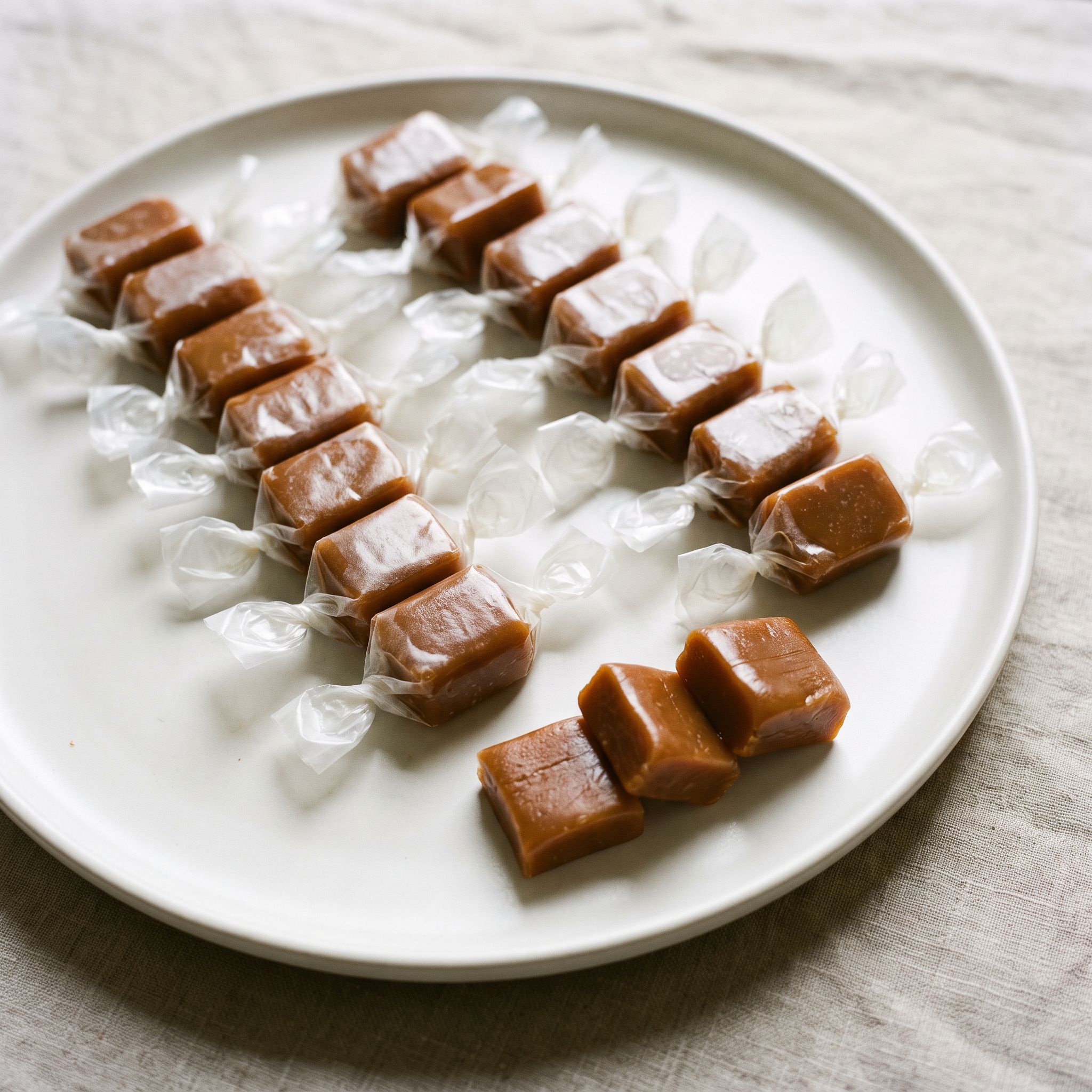
Description
Sugar heated alone reaches 160 degrees Celsius and breaks into simpler sugars that join into new brown molecules. Adding cream and butter then stops further change while the mixture cools into a firm yet pliable mass.
Cultural Background
Arabs living along trade routes around the year 1000 boiled cane sugar in water to form the first hard caramel candies. These sweets reached Europe through merchants and stayed a simple boiled sugar product until the mid 1600s. French and British cooks then began stirring in milk and butter to create the softer texture still used today. Milton Hershey opened the Lancaster Caramel Company in Pennsylvania in 1886 and sold caramels across North America before turning to chocolate. In 1977 pastry chef Henri Le Roux in Brittany France added local salted butter and nuts to caramel and registered the name caramel au beurre salé. Sugar is a molecule called sucrose built from two smaller sugars linked together. When heated past 160 degrees Celsius the link breaks and the pieces rearrange into longer chains that absorb light and create brown color plus toasted aromas. Corn syrup added early keeps those chains from lining up again into crystals during cooling. The cook stops the heat at the firm ball stage near 118 degrees Celsius so enough water remains to keep the cooled candy chewy rather than brittle. Precise temperature control decides success because each extra degree changes how much water stays and how tightly the sugar chains pack. One surprising fact is that the same caramelization process that makes candy also happens on the surface of roasted meat and baked bread.
Recipe Info
PREP TIME: 15 minutes
COOK TIME: 25 minutes
TOTAL TIME: 40 minutes plus 2 hours cooling
SERVINGS: 24
DIFFICULTY: Medium
Ingredients
- 200 grams granulated sugar
- 50 grams light corn syrup
- 40 grams water
- 120 grams unsalted butter cut into pieces
- 120 grams heavy cream
- 5 grams fine sea salt
- 5 milliliters vanilla extract
Instructions
- Adult: Combine the sugar, corn syrup, and water in a heavy saucepan over medium heat and swirl once to moisten.
- Adult: Cook without stirring until the mixture reaches 160 degrees Celsius and turns deep amber.
- Adult: Remove from heat and carefully stir in the butter pieces until melted.
- Adult: Return to medium heat and slowly pour in the cream while stirring; the mixture will bubble.
- Adult: Continue cooking while stirring often until the mixture reaches 118 degrees Celsius.
- Remove from heat and stir in the salt and vanilla.
- Adult: Pour into a parchment-lined 20 centimeter square pan and let cool at room temperature for 2 hours.
- Cut into 2 centimeter squares and wrap each in wax paper.
Tips
- If the caramel turns grainy the sugar crystallized from stirring too early or from sugar crystals on the pan sides.
- Use golden syrup in place of corn syrup if needed.
- Cook the sugar 2 degrees higher next time for firmer pieces.
Nutrition
Calories: 95
Protein: 0 grams
Carbs: 12 grams
Fat: 5 grams